Best described as a fusion of Woody Allen’s Sleeper (1973) and Carl Jung’s Modern Man In Search Of A Soul (1933), Sophie Barthes’ first feature-length science fiction movie, Cold Souls, offers some striking cinematography and production design and a story that probes some exciting questions about the nature of the self. Cold Souls follows Paul Giamatti playing a version of himself preparing for a role on Broadway. In this near-future SF New York, an MRI-like machine has been developed to painlessly remove souls to treat anxiety (angst of the soul). Giamatti is struggling to find the soul of his character in a major Broadway production of Uncle Vanya and elects to have his own removed and rents the soul of a Russian poet; his performance on stage is different (if not better) but the actor soon pines for his old soul that has since been stolen. In his attempts to locate his own soul, Paul delves into the dark side of the black organ market and the harvesting of the tortured souls of poverty-stricken artists in St Petersburg. Souls are traded and smuggled by ‘soul mules’ on the black market and Giamatti chases after his own soul exploring his memories and experiences along the way.
Sophie Barthes both writes and directs Cold Souls and she has explained in interviews that the idea for the film came from a dream she had in 2005 where she imagined the extracted human soul as a chickpea. In the dream she is standing behind Woody Allen dressed in a Sleeper costume at a soul extraction clinic, as Barthes explains:
I was in the South of France watching a lot of Woody Allen movies and reading Carl Jung’s “Modern Man in Search of a Soul” so something in my brain did a synaptic connection and so I’m in that line and Woody Allen is there and a secretary comes and says that souls had been extracted and are in those boxes and the doctor will come and assess the troubles of our souls. So Woody Allen’s turn comes, he opens his box, and his soul is a chickpea so he’s super-upset and he says he’s made 30 movies, and there’s no way, this is a mistake. So in the dream, I think, “Oh my God, my idol has a chickpea! What is mine going to look like?” and I reached to open the box and the dream ends. I didn’t see it! But I was so intrigued because it means so many things. This dream is very powerful, so I was like, “Okay, I’m going to write a screenplay out of this,” because it was a very visual, funny premise
Barthes cites the problematic Allen as an ‘idol’ and his New York intellectual persona does influence the film’s style and philosophical musings. But the less said about Allen, the better. I also don’t want to do a dive into Jung’s work (maybe for a longer analysis…), but the idea of the soul more generally in SF does fascinate me.
I recently gave a paper at a science and religion workshop on the materiality of the soul in SF with Barthes’ Cold Souls and Arati Kadav’s Cargo (2019) as key case studies. Both films explicitly acknowledge the soul as a real and literal thing that can be extracted and placed into a different body. The key difference is that Cold Souls follows a linear narrative of individual souls, experiences, and Judeo-Christian concepts whereas Cargo uses an Indofuturist mode of reimagined Hindu/Buddhist traditions. Cargo is a cyclical narrative of reincarnation and working towards the union of the collective human soul (Ātman) with God (Brahma). Death is not the end for a soul in either Judeo-Christian or Hindu-Buddhist theology, but interventions from SF allow for discussion of what part of human identity and experience lives on after death and how fast-paced developments in science and technology could potentially alter this.
Everything should be first-rate in a person, his face, clothes, soul and thought – Anton Chekhov
Paul Giamatti decides to have his soul removed because he is struggling with finding the soul of the titular character of Anton Chekov’s play Uncle Vanya and disentangling his own neurosis from the character he plays. The actor’s anxious overthinking of his performance – his troubled soul – is seen as a weakness and a hindrance. Uncle Vanya is about the unfairness of everyday middle-class life – that purposely reflects the experiences of much of the theatre-going audience – problems that cause daily tension and disappointment but never develop into anything grandiose or theatrically dramatic like murder. In Chekov’s plays much of the drama happens off-stage and audiences are left to watch the reaction of the characters to these events. The play teeters at the line between comedy and tragedy, truth and fiction, self and other and the film’s version of Paul Giamatti struggles to grasp his character as the play’s opening night draws closer. In desperation, his agent suggests a solution found in a New Yorker profile of a startup that lets you remove and store your soul if “your life is weighing you down” (now defunct, there was a fake but fully functional The Soul Storage Company website – fascinating cyber marketing for a relatively small scale film).
“A twisted soul is like a tumour, better to remove it!”
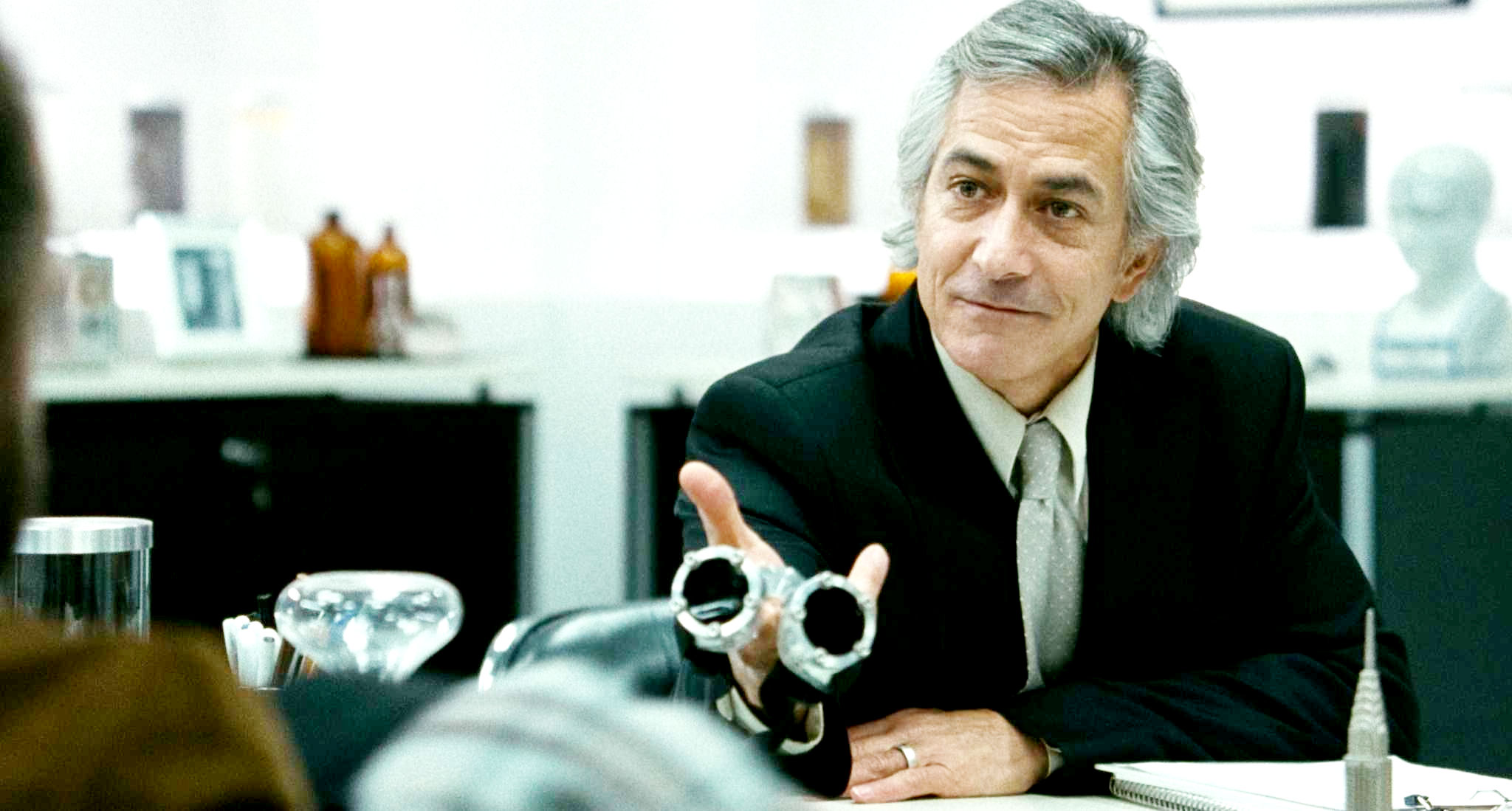
Dr Flintstein (David Strathairn), Cold Souls
The face of The Soul Storage Company (SCC) is the unsubtly named Dr Flintstein (who am I kidding, I LOVE me a Frankenstein pun, played by David Strathairn) who represents a credulous scientific positivism and progressivism that places rapid scientific and technological change over ethical considerations. These scientists discovered that they can remove souls, but does that mean that they should? Flintstein and the SCC see the body as an assemblage of organs and muscles, encased in a skeleton and controlled by the mind. The soul is a biologically unnecessary burden, a tumour even. As Barthes explains: “I believe that the desire to be artificially released from the troubles of the soul (from drugs to soul extraction and soul rental) is part of our obsessive quest for well-being”. In removing his soul Paul’s mind and sense of self he is disconnected from his body, and his performance on stage become quite unhinged.
Paul: How did we come to this? Flintstein: Progress!
Removing his soul does not resolve Paul’s problems, he becomes detached and his onstage performance lacks depth; he is a shell delivering lines and stage directions with no connection to either the character or his own body. He returns to the SCC but instead of being able to reconnect with his own soul (it’s missing, possibly at their facility in New Jersey) he takes the soul of a tortured Russian poet. Her trauma and memories begin to flash across Paul’s consciousness – her soul gives his performance depth but he feels guilt for her trafficked soul and longs for his own. Flintstein eventually admits his soul has been stolen by a Russian mobster who wanted the soul of a ‘famous American actor’ like Al Pacino or maybe Sean Penn for his soap actress girlfriend. Instead, she gets Paul Giamatti. I love how disgusted Paul is to discover his soul is being used by a moll actress (Sveta, played by Katheryn Winnick) in a trashy Russian soap opera.
One of the more interesting discussions in the film considers what happens to the stolen/rented soul if the donor dies. Like Paul, the donor tries to recover her soul. But it’s gone. Illegally smuggled and untraceable. She chooses to kill herself rather to live out her life as a soulless shell. The soul mules – explored through the character of Nina (Dina Korzun) who guiltily helps Paul recover his soul from Russia – retain fragments of the souls that they carry. Souls fragment during the process and only 95% of the soul is removed. Therefore, soul mules who take and pass on the soul cargo accumulate soul fragments that may ultimately mean they can’t be reunited with their own soul. Their fragmented memories and experiences merge with the souls they have carried giving them an intense intimate connection to that person and a distance from their own lived experiences.
Sveta (Katheryn Winnick) and Nina (Dina Korzun) buying and selling souls
Cold Souls tackles classic SF questions about what is to be human, to be an individual, and truly ourselves. Questions that are exacerbated in the face of rapid changes in medicine and technology that can often destabilise our definitions of these concepts. I can’t wait to see more of Sophia Barthes SF as trailers for her next SF The Pod Generation (2023) begin to appear on my socials. The Pod Generation also looks like it will focus on discussions of self and identity but in relation to gender and reproduction as it imagines a future of human ectogenesis – reproduction outside the human body. Barthe imagines a future where reproductive labour can be shared out and disentangled – or like the souls in Cold Souls extracted – from the bodies of people who can become pregnant. Like the emergent soul extraction business of Cold Souls, The Pod Generation marketises the process and the trailers give off vibes of Gattaca (Niccol, 1997) and the 2020 TV adaptation of Brave New World.Ectogensis opens up feminist discussions about assumptions about which bodies should be permitted or expected to go through this (often dangerous) life and body-altering experience, as Sophie Barthes continues to explore the SF genre and the big ethical questions it opens up.
More from this director:
The Pod Generation (2023) – review and podcast coming soon!
Madame Bovary (2014)
2012 ‘La Muse’ by Sophie Barthes with Michael Stuhlbarg (Short) as part of Hopper Stories (2012




1 thought on “Cold Souls (2009)”